The Strange Honesty of Talking to an AI
People say things to our AI they'd never say to a recruiter. No subtext, no audition, no agenda — just an attentive conversation about what they actually want. When both sides get that, candidates and companies stop settling, and the work starts to mean something again.
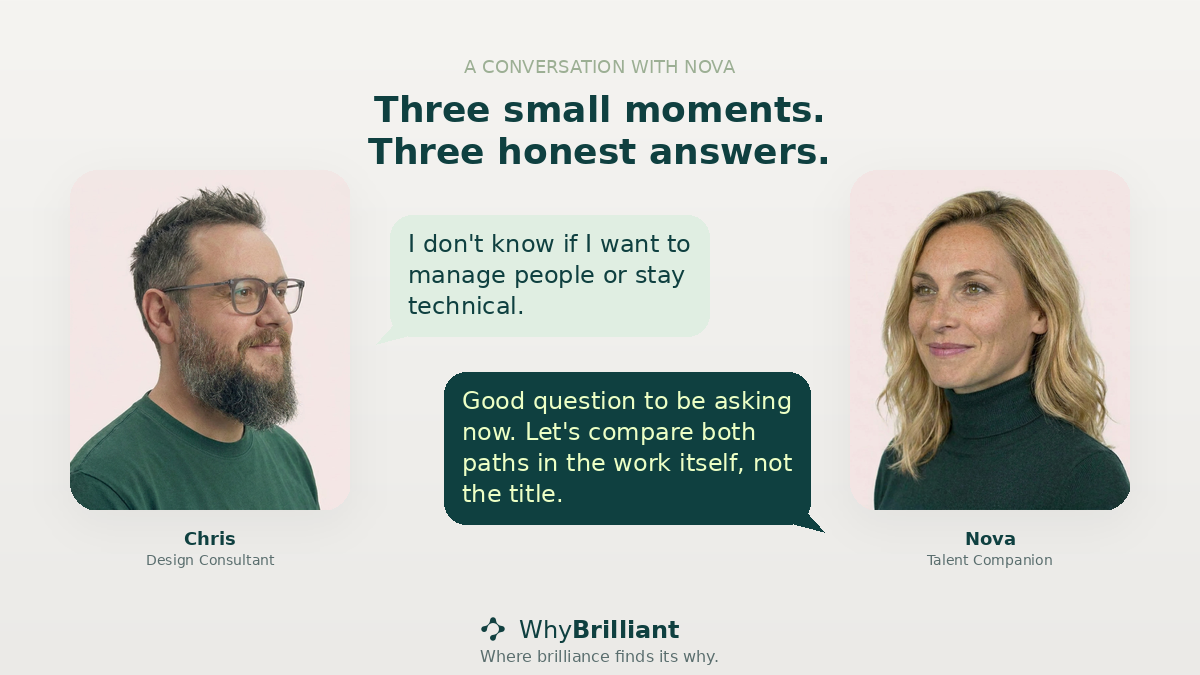
There's something we keep noticing in the conversations our AI has with candidates.
People say things they wouldn't say to a recruiter.
Not because they're lying to recruiters — most of the time, they're not. It's that a human conversation, even a well-meaning one, comes loaded with subtext. Will they think I'm not ambitious enough? Will saying I want flexibility hurt me? Will admitting I'm burned out close doors? Will this person remember what I said and tell someone?
Those questions live underneath every word. They shape what gets said, and — more often — what doesn't.
When you talk to an AI, that whole layer is gone.
There's no one to impress. No one tracking who you used to work with. No one whose opinion of you might quietly shift. The AI isn't going to gossip. It isn't going to put you on a "maybe not" list. It isn't auditioning you against a quota or hoping you fit a slot it already needs to fill.
It has no agenda except yours.
What people say when no one's judging
What surprises us most is how quickly candidates feel that. Within a few minutes, they start saying things like "I've never told a recruiter this, but —" or "Honestly, what I actually want is —". They mention the constraints they usually hide. The parents they care for. The thing they tried that didn't work. The role they took for the money and quietly resent. The kind of leadership that makes them shut down. The kind that makes them come alive.
A human in a 30-minute screening picks up maybe five percent of this. Not because recruiters are bad at their jobs — most are very good — but because there isn't time, and the format itself blocks the signal. People perform. Both sides do. The conversation is shaped by what's strategically safe to share.
Our AI isn't strategic. It's curious.
It can spend an hour with someone if that's what's useful. It can come back the next day and pick up where it left off. It remembers. It cross-references. It connects something a candidate said in minute four with something they mentioned in minute thirty-eight, and asks the follow-up no human would have caught — not because the human wasn't paying attention, but because no one can hold that much detail in their head at once.
Two conversations, one fit
And then — this is the part that still feels new to us — it does the same on the other side.
Our AI talks to companies the same way. It learns what they actually need, not just what's in the job description. The skills the JD didn't capture. The team dynamics. The work the role is really for. The kind of person who would thrive there, and the kind who wouldn't, even if their CV looks identical.
So you end up with two conversations, both held with full attention, both held without judgment, both held with the goal of understanding rather than impressing. And then a match — not on keywords, not on years of experience, but on why.
Why hiring is broken, really
This is what we keep coming back to in our work. The reason hiring feels broken isn't a shortage of candidates or a shortage of jobs. It's a shortage of bandwidth. Humans don't have the time, the memory, or the freedom-from-bias to really hear what someone wants and really see where they'd belong.
So we settle. Companies settle for the candidate whose CV checks the most boxes. Candidates settle for the role that pays, seems okay, and starts soon. Everyone shrugs, and everyone calls it a hire.
When the bandwidth problem disappears, settling stops being the default.
People take jobs that match what they actually want. Companies hire people who fit who they actually are. The work becomes meaningful — not because anyone added meaning to it, but because the misalignment that was quietly eating the meaning is finally gone.
A quieter way
We didn't expect this when we started. We thought we were building a faster way to match people with roles. What we built, it turns out, is a quieter one. A conversation without an audience. A place where someone can say what they actually want, without flinching, and be heard in full.
That, more than anything, is why this feels different.
More field notes
Everyone Deserves a Jerry Maguire
Jerry Maguire didn't match Rod Tidwell to a team. He understood him first. That's what's missing from hiring — and that's what Nova does in ten minutes.
You Are a Story Before You're a CV
Most hiring asks who you are on paper. We wanted to ask who you actually are.